--enable-auto-failover seçeneği
Şöyle yaparız
./couchbase-cli setting-autofailover -c <IP-node1>:8091 -u username -p password--enable-auto-failover 0
./couchbase-cli setting-autofailover -c <IP-node1>:8091 -u username -p password--enable-auto-failover 0
Like HTTP Basic Authentication, HTTP Digest Authentication authenticates a user based on a username and a password. However the authentication is performed by transmitting the password in an ENCRYPTED form which is much MORE SECURE than the simple base64 encoding used by Basic Authentication, e.g. HTTPS Client Authentication. As Digest Authentication is not currently in widespread use, servlet containers are encouraged but NOT REQUIRED to support it.The advantage of this method is that the cleartext password is protected in transmission, it cannot be determined from the digest that is submitted by the client to the server.Digested password authentication supports the concept of digesting user passwords. This causes the stored version of the passwords to be encoded in a form that is not easily reversible, but that the Web server can still utilize for authentication. From a user perspective, digest authentication acts almost identically to basic authentication in that it triggers a login dialog. The difference between basic and digest authentication is that on the network connection between the browser and the server, the password is encrypted, even on a non-SSL connection. In the server, the password can be stored in clear text or encrypted text, which is true for all login methods and is independent of the choice that the application deployer makes.
Each TCP segment contains the sequence number of the next byte that the sender of the acknowledgement expects to receive from the remote host.

The default go-back-n retransmission strategy used by TCP has the advantage of being simple to implement, in particular on the receiver side, but when there are losses, a go-back-n strategy provides a lower performance than a selective repeat strategy.

The fast retransmit heuristic improves the TCP performance provided that isolated segments are lost and the current window is large enough to allow the sender to send three duplicate acknowledgements.When losses are not isolated or when the windows are small, the performance of the fast retransmit heuristic decreases. In such environments, it is necessary to allow a TCP sender to use a selective repeat strategy instead of the default go-back-n strategy.
The SACK option is negotiated between the TCP endpoints, and is only used if support is advertised by both sides of a connection.Daha detaylı açıklama şöyle.
Selective Acknowledgment (SACK) TCP was another TCP proposal in 1996, in RFC 2018. The earlier variants 8f TCP, even back to Tahoe, implement a cumulative acknowledgment scheme where a lost packet results in duplicate ACKs for each subsequently received packet. Relying purely on the cumulative acknowledgment scheme can lead to inefficiencies when packets are lost. An example of this is a case where 10,000 bytes are sent in 10 different TCP packets, and the first packet is lost during transmission. Using cumulative acknowledgment scheme, the receiver cannot say that it received the bytes 1,000 to 9,999 successfully, and only failed to receive the first packet, containing bytes 0 to 999. Thus the sender may then have to resend all 10,000 bytes.Selective Acknowledgement (SACK) Yapısı Nasıldır
                     +--------+--------+
                     | Kind=5 | Length |
   +--------+--------+--------+--------+
   |      Left Edge of 1st Block       |
   +--------+--------+--------+--------+
   |      Right Edge of 1st Block      |
   +--------+--------+--------+--------+
   |                                   |
   /            . . .                  /
   |                                   |
   +--------+--------+--------+--------+
   |      Left Edge of nth Block       |
   +--------+--------+--------+--------+
   |      Right Edge of nth Block      |
+--------+--------+--------+--------+Paketlerin sırasının bozuk olması SACK gönderilmesine sebep olur. Gönderilen SACK şöyledir.0 - 500, 900 - 1100 ve 1300 - 2000 ?
TCP ACK - 501 (in TCP header, not in SACK Option)
TCP SACK - 1st block Left Edge  - 900
TCP SACK - 1st block Right Edge - 1100
TCP SACK - 2nd block Left Edge  - 1300
TCP SACK - 2nd block Right Edge - 2000
(all in the same Segment)
The definition of transcoding is the process of converting an audio or video file from one encoding format to another in order to increase the number of compatible target devices on which a media file can be played.
Transcoding term includes these two terms: Transrating and Transsizing.Transrating specifically refers to changing bitrates, such as taking a 2k video input stream at 16 Mbps and converting it into lower-bitrate streams like 720p at 5 Mbps (the process is also called renditions).Transsizing specifically means resizing the video frame; for example, from a resolution of 2560×1440 (2K UHD) down to 1920×1080 (1080p), 1280×720 (720p), or 720×480(480p)
Transcoding Is not the same as transmuxing. Transmuxing is also called recoding, repacking, packaging, or repacking. Transmuxing is a process where you take compressed audio and video and pack/repack it in different formats with keeping audio or video content original.For example, you might have H.264/AAC content and change the container in which it is packaged so you can use it HTTP Live Streaming (HLS), Smooth Streaming, HTTP Dynamic Streaming (HDS), or Dynamic Adaptive Streaming over HTTP (DASH). The computational overhead for transmuxing is much smaller than transcoding.
WebRTC (Web Real-Time Communication protocol) is an open-source standard for real-time communication supported by almost every modern browser, including Safari, Google Chrome, Firefox, Opera, and others. WebRTC supports Opus audio codec as well as high-quality VP8 and VP9. In the near future, the protocol will gain support for a brand new AV1 video codec. The protocol is expected to be used in a much wider area.One of the biggest advantages of WebRTC is that it converts millions of browsers into streaming terminals without the need to install any additional plugins. What’s more, WebRTC supports sub-second latency, which means no more delay(as we mentioned, the audience hates delay)! Finally, the protocol uses an adaptive bitrate technology that allows it to automatically adjust video quality and avoid any interruptions and interruptions.
Streaming latency is basically the delay between the camera capturing an event and the event being displayed on viewers’ devices. It takes time to transfer the content from the source to the viewers’ devices. The time of this period depending on the type of live streaming directly affects the success of the live broadcast.
- Taking care of session management- Managing all Session Description Protocol (SDP) message exchanges and handling negotiations through ICE candidates (uses STUN and Turn if required)- Encoding and decoding media streams (audio/video/text) in real-time- Handling all network-related issues such as bandwidth estimation, packet loss etc.
That’s where the roles of STUN (Session Traversal Utilities for NAT) and TURN (Traversal Using Relays around NAT) servers come into the picture.This is how the process goes:- A request for public IP address is sent to STUN/TURN servers.- Now, this server responds with the IP address that it perceives correct.- It creates a set of Interactive Connectivity Establishment (ICE) that contains IP address, port, and transport protocols.- With this information about the public IP and port, it easily connects with the peer.- The peer browser, on the other hand, does the same thing while using the STUN or TURN server.Here it is to be noted that signalling is not a part of the WebRTC framework, it was left out for valid reasons. Different applications might need different protocols and the working group for WebRTC did not want to limit the choices for developers.
Some people recommend making your software robust by working around problems automatically. This results in the software “failing slowly.” The program continues working right after an error but fails in strange ways later on. A system that fails fast does exactly the opposite: when a problem occurs, it fails immediately and visibly. Failing fast is a nonintuitivetechnique: “failing immediately and visibly” sounds like it would make your software more fragile, but it actually makes it more robust. Bugs are easier to find and fix, so fewer go into production.
The important part here is the kind of error you encountered. There are errors that are expected, and where you know what to do with them. Typical examples are network errors, e.g. in your web application you need to display an error if the server doesn't respond, and probably give the user a button to retry. You don't want to crash everything for this kind of error that you can cleanly handle.Another type of error are those that simply make the current job impossible. For example if you need to read 100 different files for a specific job, if any of them fails you don't need to continue, it is impossible to complete the job. So you don't need a try/catch around every file access, you can let the whole thing either succeed completely, or let if fail on any error.The most important error, and the one this statement is really about is an unexpected error that has put your application into an unknown state. Let's assume we're in an application with multiple threads and shared memory. We have a try/catch around the whole program in each thread that catches anything. Is it safe to just restart the thread if any kind of arbitrary exception is thrown?The answer is no, because of the shared state. The error could have done anything to the shared memory, and put it into a corrupt state. What you need to do is to get the program into a defined, known good state again. In most programming languages this means crashing the entire program and restarting it. You can't recover from having your application in an unknown state. Any of your assumption might be broken, there might simply be garbage data in some of your state.
One of the benefits of detecting problems as soon as you can is that you can crash earlier, and crashing is often the bet thing you can do. The alternative may be to continue, writing corrupted data to some vital database or commanding the washing machine into its twentieth consecutive spin cycle.
In these environments, programs are designed to fail, but that failure is managed with supervisors. A supervisor is responsible for running code and knows what to do in case the code fails, which could include cleaning up after it, restarting it, and so on.
The recommendation is to let a program terminate its execution ASAP when there is an indication that it cannot safely continue (the term "crash" can also be replaced by "end gracefully", if one prefers this). The important word here is not "crash", but "early" - as soon as such an indication becomes aware in a certain part of the code, the program should not "hope" that later executed parts in the code might still work, but simply end execution, ideally with a full error report. And a common way of ending execution is using a specific exception for this, transport the information where the problem occurred to the outermost scope, where the program should be terminated.Moreover, the recommendation is not against catching exceptions in general. The recommendation is against the abuse of catching unexpected exceptions to prevent the end of a program. Continuing a program though it is unclear whether this is safe or not can mask severe errors, makes it hard to find the root cause of a problem and has the risk of causing more damage than when the program suddenly stops.
Such a supervisor is either a person, which will deal with the failure of a program, or another program running in a separate process, which monitors the activity of other, more complex programs, and can take appropriate actions when one of them "fails".What this is precisely depends heavily on the kind of program, and the potential costs of a failure. Imagine the failure scenarios for- a desktop application with some GUI for managing address data in a database- a malware scanner on your PC- the software which makes the regular backups for the Stack Exchange sites- software which does automatic high speed stock trading- software which runs your favorite search engine or social network- the software in your newest smart TV or your smartphone- controller software for an insulin pump- controller software for steering of an airplane- monitoring software for a nuclear power plantI think you can imagine by yourself for which of these examples a human supervisor is enough, or where an "automatic" supervisor is required to keep the system stable even when one of its components fail.
Please don't get hung up on the fact that I mentioned PHP. one of the features of php is that it keeps trying to work even when there are errors. Most other languages stop the process flow on an error. That's a big reason for a cascade of error messages.
If the first step of parsing a file fails, then stop with an error. Don't carry on passing bad data from one step to the next.
A'dan B'Ye Tek Yönlü İletişim İstiyorsakinternet-facing computerA => air-gapped computerB
Have Computer B sit behind a router with firewall configured. The firewall allows traffic in, but drops traffic out. That's why you need an UDP service, as TCP would have to send confirmation data out, and that's forbidden.
A composition describes a relationship in which one object completely controls another object that has no independent lifecycle.İçi dolu elmas ile gösterilir.
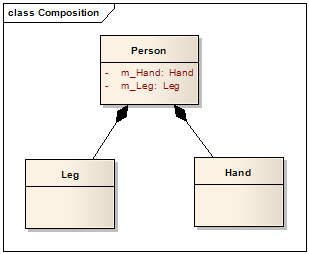
class Board {...};class Player{Board m_board;...};

